Seasonal Home Decor Refresh: Easy Styling Tips
Cassandras ShopSeasonal home decor helps you refresh your living spaces without a complete redesign. You can use color, texture, lighting, and placement to match the mood of each season. A well planned seasonal rotation also protects your budget by extending the life of what you already own. With a clear system, it becomes easier to store, swap, and maintain a consistent style year after year.
Updated on: 2026-04-25
Quick Summary | Contents | Introduction | Product Spotlight | Myths vs. Facts | Seasonal Planning Framework | Storage and Maintenance | Visual Insight | Lighting, Texture, and Color | Visual Insight | Frequently Asked Questions | Final Recommendations | Q&A Section | About the Author
Introduction
Seasonal home decor is one of the most effective ways to keep a home feeling current, intentional, and comfortable throughout the year. Instead of treating each season as a full reset, you can build a repeatable approach that aligns colors, materials, and visual weight with changing light and weather patterns. In this guide, you will learn a practical framework for choosing seasonal elements, avoiding common mistakes, and organizing your decor rotation for long term ease.
Product Spotlight
When people think about seasonal home decor, they often focus on large items such as pillows or wall art. However, smaller seasonal accents can deliver a high impact update with less effort. A compact ceramic night light can serve as a subtle seasonal signal through its sculpted form and warm glow, especially during darker months or in rooms where you want a gentle ambiance. Use it as part of your seasonal layering plan so the overall look remains cohesive rather than scattered.
For example, you can match the night light location to your seasonal theme. In an entryway, it supports an inviting “arrival” feeling. In a reading nook, it complements warm tones and helps create a calm mood during evenings. If you prefer a consistent animal motif theme across seasons, you can rotate pieces based on the mood you want to express.
- Choose placement first, then select seasonal accents around that focal point.
- Prioritize warm lighting effects for evenings and cooler color palettes for daytime.
- Use consistent materials to connect seasonal elements to your base style.
To explore a seasonal friendly option, you may consider: koi fish ceramic night light.
Myths vs. Facts
Myth: Seasonal decor requires constant new purchases
Fact: Seasonal home decor can be built through rotation and repositioning. If you already own a core set of neutrals and complementary textures, you can refresh the look by swapping a few accent items such as textiles, small decor, or lighting placement.
Myth: Only bold colors count as seasonal
Fact: Seasonal updates can be achieved with texture and lighting. Warmer fabrics, matte finishes, and soft illumination often create a stronger seasonal mood than color alone.
Myth: Small spaces cannot support seasonal changes
Fact: Small spaces benefit from compact, strategic updates. A single focal accent, such as a night light on a shelf, can carry the theme without crowding the room.
Seasonal Planning Framework
To make seasonal home decor sustainable, plan in layers. Think of your home as a canvas with a stable foundation and a rotating highlight set. This method prevents visual overload and reduces decision fatigue.
Step 1: Define your base style
Your base style is the set of colors and textures that stays consistent all year. Common base styles include warm neutrals, cool minimalist palettes, and nature inspired earth tones. Once your base is defined, seasonal additions become easier to coordinate.
Step 2: Select one seasonal theme per room
Choose one idea for each room, such as “coastal calm,” “autumn warmth,” or “winter softness.” Keep the theme consistent within that space. This reduces mismatch and supports an intentional, editorial look.
Step 3: Use a focal point and supporting elements
For each room, choose one focal point. It could be a shelf, a mantel, or a bedside surface. Then support it with smaller accents that echo the same palette or material family.
- Focal point: anchoring item that holds attention.
- Supporting elements: items that repeat colors, textures, or silhouettes.
- Background structure: curtains, rugs, or wall colors that set tone.
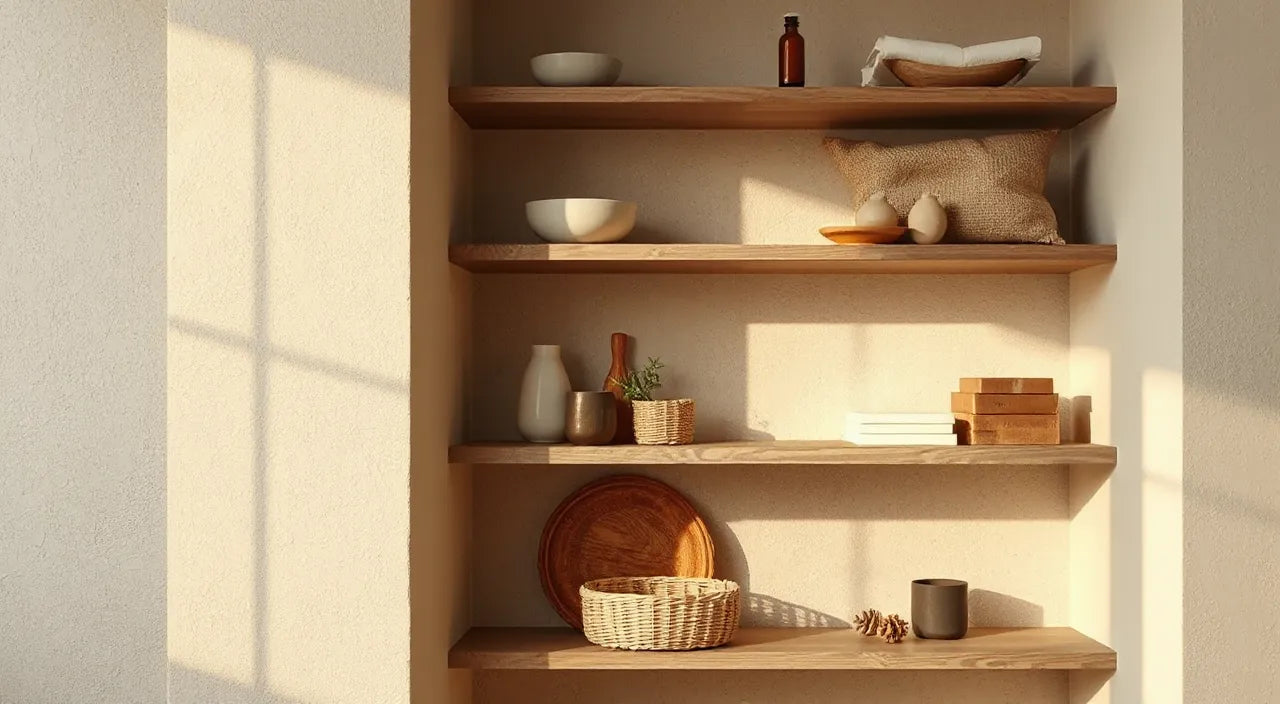
Layered seasonal mood: warm glow, textured neutrals, tidy shelves
Storage and Maintenance
Seasonal home decor often fails not because the style is wrong, but because the system is inconsistent. Proper storage protects textiles, preserves finishes, and keeps your rotation smooth when the calendar shifts.
Organize by category, not by season
Instead of storing “winter items” in one place, store by category. Textiles in one location, lighting accessories in another, and small decor in labeled bins. When you decide on a theme, you can pull items by category quickly.
Use protective materials
For delicate finishes, use tissue paper or fabric wraps. For ceramics and sculpted decor, keep pieces separated with padding so they do not rub during storage movement.
Keep an inventory list
Write a simple internal list for yourself. Include categories and where each bin lives. This practice reduces the time spent searching and helps you plan more confidently.
For an evergreen approach, focus on quality over quantity. A small set of well preserved accents can create more seasonal variety than a large pile of items that is hard to manage.
Lighting, Texture, and Color
Lighting is the fastest route to seasonal atmosphere. Texture is the fastest route to seasonal depth. Color is the final layer that signals the season most clearly. When you combine all three, the effect becomes coherent and not accidental.
Lighting: warm for comfort, controlled for balance
During cooler months and shorter evenings, warm tones help the home feel more welcoming. Use warm light near focal points, and keep overhead brightness moderate if you want a calmer atmosphere. Even in minimal rooms, a small warm light source can add emotional comfort.
Texture: matte, knitted, and naturally inspired finishes
Texture creates seasonal contrast. In autumn and winter, knitted and woven textures read cozy. In spring and summer, lighter textures and smoother surfaces feel airy. Choose textiles and surfaces that match how you want the room to feel.
Color: choose a palette with continuity
Seasonal color does not have to be loud. Select one dominant seasonal color, one supporting neutral, and one accent tone. Continuity matters more than intensity. For example, if your base is neutral, you can add season color through throws, small art, and lighting placement rather than painting or major renovations.
- Dominant: the main seasonal signal.
- Supporting neutral: keeps the palette cohesive.
- Accent tone: small highlights that create visual rhythm.
When selecting accent pieces, consider how they interact with your existing decor. If you want an animal themed angle for seasonal storytelling, you can pair sculpted accents with your palette. For instance, you may align a nature motif night light with a coastal, woodland, or winter sky theme using only color and placement.
If you want additional inspiration for a seasonal vibe, you can also visit Jovia Paws for related home and lifestyle styling ideas.

Seasonal lighting map: focal glow zones and color accents
Frequently Asked Questions
How do I start seasonal home decor if I have limited storage?
Begin with a minimal rotation system. Choose a small number of high impact items such as lighting accents, one or two textile pieces, and a single focal decoration per room. Store them by category so you can assemble new looks quickly without overbuying.
What is the best way to keep seasonal decor from looking cluttered?
Use one focal point per room and limit the number of supporting items. Select colors from a shared palette, then repeat those colors through texture and small accents. If you add a seasonal element in one area, remove a competing element elsewhere to preserve balance.
Can seasonal home decor work in open concept spaces?
Yes. In open concept layouts, define zones and apply one theme to each zone. Keep the color palette consistent across zones so transitions feel smooth. Lighting placement also helps: use warm accent lighting to unify adjacent areas.
Final Recommendations
Seasonal home decor becomes easier when it is treated as a planned system rather than a last minute purchase cycle. Use a stable base, select one theme per room, and build each look from a focal point plus a controlled set of supporting accents. Protect your investment with careful storage and a simple inventory method.
To move from planning to action, start with one room. Choose the area where lighting and comfort matter most, such as an entryway, a living room corner, or a bedside setting. Then rotate one lighting accent and one textile element to establish the seasonal mood. After that, refine with smaller decorative details only if they add clarity to the theme.
- Adopt a “base plus rotation” mindset.
- Plan by category for faster swaps.
- Use warm lighting and varied texture for stronger seasonal impact.
- Limit supporting accents to maintain visual balance.
Q&A Section
Which season change is easiest to notice without buying many items?
Lighting changes are often the easiest. Swapping or repositioning a warm light source, adjusting placement, and choosing textiles in a matching palette can shift the mood clearly while keeping the core decor intact.
How many accent pieces should I rotate per room?
A practical range is two to five accent pieces per room. Include one focal item and two to four supporting items. This number preserves clarity while still delivering a noticeable seasonal difference.
What materials work well across multiple seasons?
Natural and neutral materials tend to transition smoothly. Matte ceramics, woven textures, and simple silhouettes pair well with warm and cool color palettes. By changing color accents and lighting warmth, the same materials can support different seasonal moods.
Disclaimer: This article provides general styling guidance. Lighting warmth, color perception, and visual outcomes vary by room conditions, personal preference, and product specifications.
The content in this blog post is intended for general information purposes only. It should not be considered as professional, medical, or legal advice. For specific guidance related to your situation, please consult a qualified professional. The store does not assume responsibility for any decisions made based on this information.